Hybrid cloud has become the foundation of modern IT thanks to its ability to blend the scalability of public cloud with the control of on-premises infrastructure.
From network and data security to AI-enabled automation, the world’s top technology companies are reimagining what a connected, resilient enterprise looks like.
Top hybrid cloud leaders are defining the next frontier of agility and data sovereignty, powering global innovation through unified, intelligent and adaptive cloud ecosystems.
Technology Magazine looks into the top 10.
10. Cisco+ Hybrid Cloud
Company: Cisco
Founded: 1984
HQ: California, US
Employees: 86,200

Sometimes likened to the ‘connective tissue’ of hybrid cloud, Cisco is a major player in the space.
The company’s Cisco+ Hybrid Cloud portfolio unifies networking, security and management to provide full-stack observability across multi-cloud environments.
Cisco is a leader in edge computing, offering specialised hardware for AI workloads and automated provisioning through the Intersight platform.
As organisations move toward modular, service-based architectures, Cisco’s solutions ensure secure, low-latency communication between applications and data across any location.
9. HPE GreenLake
Company: HPE
Founded: 2015
HQ: Texas, US
Employees: 61,000

HPE GreenLake is a leader in infrastructure consumption services, offering an edge-to-cloud operating model with pay-per-use economics.
HPE has integrated Morpheus software and Juniper Networking’s AI-driven tools to deliver automated, zero-trust security and seamless connectivity across hybrid sites.
GreenLake provides a “buffer” of on-premises capacity that is only paid for when used, cutting over-provisioning by up to 60%.
With a focus on Private Cloud AI in partnership with Nvidia, HPE enables enterprises to deploy GPU-rich clusters locally, ensuring that critical workloads are protected and optimised for AI.
8. Dell Apex Hybrid Cloud
Company: Dell
Founded: 1984
HQ: Texas, US
Employees: 108,000

Dell is a dominant force in the hybrid landscape thanks to Dell APEX, a suite of solutions providing a consistent management experience across all environments.
Dell leverages its market-leading server and storage hardware to deliver cloud-like agility on-premises. APEX enables organisations to scale resources elastically, protecting investments with adaptable hybrid solutions that avoid costly re-platforming.
A focus on reliability, security and operational simplicity makes APEX a strong choice for enterprise-grade hybrid storage and compute.
7. Oracle Cloud Infrastructure
Company: Oracle
Founded: 1977
HQ: Texas, US
Employees: 162,000

Oracle Cloud Infrastructure (OCI) is celebrated as a versatile hybrid provider, delivering more than 200 services across public, dedicated and hybrid environments.
Its Cloud@Customer solution brings the full power of OCI and the Autonomous Database into customer data centres, meeting the strictest sovereignty and latency requirements.
Oracle’s multicloud strategy allows for seamless split-stack architectures, running databases on OCI while applications reside on Azure or AWS.
6. VMware Cloud Foundation 9.0
Company: Broadcom
Founded: 1961
HQ: California, US
Employees: 37,000

Now under the ownership of Broadcom, VMware Cloud Foundation (VCF) 9.0 is a major weight in the hybrid cloud market thanks to its ability to deliver a unified platform that integrates compute, storage, networking and security.
It simplifies infrastructure management and automates lifecycle operations, enabling cloud-like agility in private data centres.
Focused on Private AI and sovereign cloud capabilities, VCF 9.0 supports mission-critical workloads with enterprise-grade reliability through features like vMotion and High Availability.
5. IBM Cloud
Company: IBM
Founded: 1911
HQ: New York, US
Employees: 270,300

Armed with a hybrid-by-design focus, IBM Cloud is specifically engineered for highly regulated sectors.
Its strategy centres on Red Hat OpenShift, a leading platform for container orchestration across hybrid environments.
IBM enables organisations to modernise legacy virtual machines alongside cloud-native containers using OpenShift Virtualization, facilitating a stable transition to AI-driven architectures.
With a focus on Private AI and data sovereignty, IBM provides modular solutions that keep sensitive data secure.
4. Google Cloud Platform
Company: Alphabet
Founded: 1998
HQ: California, US
Employees: 187,000
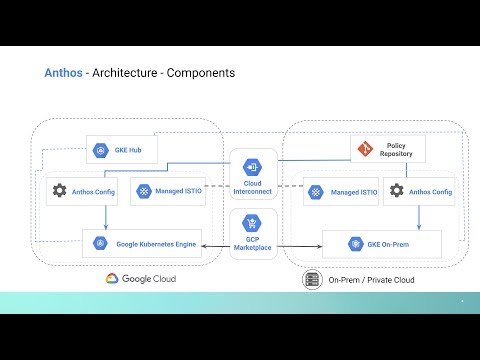
Google Cloud is a major player when it comes to data-driven hybrid solutions, holding an 11% market share.
Its flagship platform, Google Anthos, allows for consistent resource management across on-premises servers and multiple public clouds.
Google Distributed Cloud (GDC) extends this by bringing advanced AI and BigQuery capabilities to the edge for latency-sensitive workloads.
Known for its leadership in Kubernetes and ML, GCP is the top choice for organisations prioritising data analytics and AI-first modernisation.
3. Nutanix Cloud Platform
Company: Nutanix
Founded: 2009
HQ: California, US
Employees: 7,800

An independent hybrid multicloud leader, Nutanix delivers a unified platform for applications and data across any location.
Nutanix Cloud Platform (NCP) offers a consistent operating model that reduces complexity.
As well as this, its Nutanix Kubernetes Platform (NKP) simplifies the management of containerised applications from the core to the edge.
By providing native virtualisation and integrated data services, Nutanix empowers organisations to deploy AI and manage workloads with lower Capex and predictable costs, making it a powerful alternative to traditional hyperscaler-centric models.
2. AWS
Company: Amazon
Founded: 1994
HQ: Washington, US
Employees: 1,556,000

AWS is a global leader when it comes to cloud infrastructure, responsible for a 31% market share.
Its hybrid strategy is powered by AWS Outposts, which brings native AWS hardware and services to customer data centres for low-latency and data-resident workloads.
AWS excels in providing a massive service catalogue of more than 200 features, including advanced AI chips and quantum computing tools.
Having invested more than US$100bn in data centres globally, AWS is working to ensure it has unmatched scalability and maturity for organisations requiring high-performance computing and global reach.
1. Microsoft Azure
Company: Microsoft
Founded: 1975
HQ: Washington, US
Employees: 228,000

Microsoft Azure’s adaptive cloud framework is built on Azure Arc and Azure Local.
This approach provides a unified control plane that extends Azure’s management, security and AI services to any environment.
By integrating seamlessly with existing Microsoft ecosystems like SQL Server and Office 365, Azure simplifies the modernisation of legacy workloads.
Its strength in distributed hybrid infrastructure allows enterprises to run cloud-native services like AKS anywhere, including disconnected sites.
With a 25% global market share and 30% revenue growth, Azure is the leader for resilient, AI-ready enterprise hybrid computing.