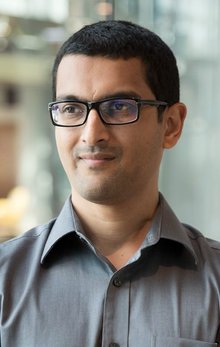
From Aadhaar to JuliaHub: Viral Shah’s Computing Revolution

For Viral Shah, Co-Founder and CEO of JuliaHub, life’s work has always been defined by a singular drive: solving massive, complex problems that create real-world impact at scale.
Early in his career, Viral witnessed the transformative power of foundational technology first hand while developing the computational infrastructure for India’s Aadhaar programme, an identity project scaling to over a billion people.
It was this same obsession with scale and efficiency that drove him to co-create the Julia programming language, solving the notorious "two-language problem" and revolutionising technical computing for more than a million global users.
Today, under his leadership, JuliaHub is leveraging world-class compiler expertise to tackle some of the planet’s most urgent challenges – from climate change and electrification to the semiconductor shortage.
Through its pioneering industrial scientific machine learning (SciML) platform, Dyad, JuliaHub is entering the next frontier of innovation. By blending cutting-edge computing with deep scientific knowledge, the team has built physics-aware, agentic AI copilots that act as true collaborators for engineers.
Here, Viral discusses the “aha!” moment that sparked a computing revolution, the evolution from developer to global CEO, and how physics-based AI is drastically accelerating the future of industrial R&D.
What is JuliaHub and what role does it play in the scientific computing space?
At its core, JuliaHub provides advanced, AI-driven simulation and design solutions for hardware engineering. We help organisations solve complex product development challenges by eliminating the bottleneck between initial design concepts and validated, real-world performance.
Our flagship platform, Dyad, acts as an autonomous engineering partner. Paired with the leading LLM technologies, Dyad can generate, simulate and validate complete physical designs from scratch.
By seamlessly integrating rigorous physics-based modelling with AI workflows, Dyad automates system simulation while strictly enforcing physical laws – drastically reducing design cycles, mitigating prototyping risks, and accelerating time-to-market.
What makes Dyad uniquely capable is its foundation on the Julia platform and language. Today, Julia is the industry standard for high-performance scientific computing, trusted to run mission-critical simulations by over 1,000,000 users across 10,000 companies globally.
Built by an award-winning team of scientific computing pioneers, JuliaHub leverages this unmatched computational power to define the future of AI-driven industrial R&D, empowering engineering teams to build the next generation of physical systems faster and more reliably.

You co-created the Julia programming language back in 2009 out of a shared frustration with existing tools. Looking back, when did you realise the world needed an entirely new programming language, not just a new library?
The true "aha!" moment in 2009 came from compilers, the technical core of what we do, being a general-purpose technology to combine ideas and create products.
Compilers are far more powerful in their generality around solving a large number of problems across multiple domains, as opposed to libraries that can only solve specific problems for areas they were conceived for.
We didn’t want to just solve one specific problem; we wanted a general-purpose technology capable of combining entirely different ideas to create new products.
If you build a library – say, a partial differential equation library designed for computational fluid dynamics (CFD) – it can only ever solve CFD problems.
It is trapped in the domain it was conceived for. A compiler, however, operates at a level of generality that can solve a massive number of problems across multiple domains simultaneously.
That realisation shaped our entire trajectory: we built Julia as a programming language for scientists, and we built Dyad as a physics compiler for engineers.
Because they are built on compiler architecture rather than rigid libraries, Julia and Dyad aren’t locked into a single niche. They can seamlessly break down barriers to solve complex, multi-physics, multi-scale and multi-domain problems that traditional software tools could never touch.
You’ve been a computer scientist, a researcher, an author and now a tech CEO. How has your relationship with the Julia language changed now that your daily focus is less on writing code and more on scaling a global enterprise company?
It’s been a fascinating evolution. In the early days, my relationship with Julia was very intimate; it was about solving the two-language problem, compiler performance and proving a technical thesis.
Today, as CEO of JuliaHub, my focus has shifted to empowering product development organisations around the globe with this technology to solve their toughest engineering problems – and ultimately delight their customers.
Having worked in the trenches building Julia with some of the smartest engineers at MIT and around the world, I am now able to bring those ideas to our customers, solving the world’s most complex problems.
With the use of autonomous agents, I have also been able to stay anchored to the community and Julia development itself. This mirrors many CEOs and senior executives who continue to use AI to jump back into code.
How does Dyad 3.0 transform physical systems design, and what does it mean for the future speed and intuition of industrial R&D?
Traditionally, physical systems design is slow and fragmented. Engineers spend weeks manually building rigid mathematical models in legacy software, running slow simulations, and tuning parameters by hand.
Dyad 3.0 completely upends this by introducing agentic simulation. Instead of just chatting, its autonomous engineering agents are integrated directly into a physics-based simulation engine.
Engineers can provide plain-language requirements or a PDF specification, and the agent automatically researches the mathematics and builds the multi-physics model.
Crucially, the agent is physics-aware. It automatically self-corrects its code to strictly enforce conservation laws and unit consistency, preventing hallucinations – the biggest challenge to wide-scale adoption of AI by engineers.
Powered by Julia and SciML, it accelerates simulations up to 100x and can instantly compile designs into embedded C code for physical hardware. For industrial R&D, this delivers a 10x productivity boost.
By automating tedious model-building, Dyad 3.0 frees engineers to focus on high-level innovation, allowing companies to design hardware at the speed of software.
You had a six-week trial with Binnies where Dyad detected specific pump faults with up to 95% accuracy. How can it change day-to-day operations?
Up to this point in our conversation we’ve talked a lot about the design phase of a product lifecycle. Of course, building the best product correctly the first time delivers tremendous value to our customers.
Our technology is also a unique solution that enables our customers to rapidly build digital twins of their physical systems to optimize performance, costs and reliability in the operational lifecycle phase.
The Binnies case study highlights what makes Dyad different from traditional monitoring or digital twin solutions.
Rather than using separate models for design and operations, Dyad enables a single physics-based model to be used throughout the entire lifecycle of a system, from engineering and optimisation to real-time monitoring and predictive maintenance.
During the six-week trial, Dyad identified specific pump fault conditions, including early signs of bearing degradation, with up to 95% accuracy.
The real value isn’t the accuracy itself. It’s what operators can do with that insight. If a failing bearing is detected before it causes a breakdown, maintenance can be planned proactively, avoiding costly emergency repairs and service disruptions.
For a water utility, that means greater reliability for customers and less time spent reacting to unexpected failures.
The Binnies team saw the potential of using the same engineering model not only to design and understand their assets, but also to continuously monitor, diagnose and improve them in operation. That’s a powerful shift toward more resilient and efficient infrastructure.
Company portals

Executives
Viral B. Shah
Co-founder and CEO