Inside Panthalassa's Wave-Powered Data Centre in the Ocean

A US startup is deploying wave-powered floating data centres in the open ocean to meet AI's surging energy demands, backed by Silicon Valley's most influential investors.
The race to build compute infrastructure for artificial intelligence has pushed tech companies into uncharted territory.
Since 2022, the industry has scrambled to solve a fundamental problem that threatens to limit AI growth.
Data centres that run AI programs consume substantial amounts of power.
According to the IEA, the sector's energy consumption could grow 30% a year until 2030, by which point AI will account for 3% of all the world's energy use.
This demand has produced unusual infrastructure solutions.
Nuclear power plants have been rebooted, satellite solar arrays deployed and fusion reactor investments made.
One approach stands apart for its novelty – Wave power, a renewable energy source that has received little attention from the tech sector, now powers floating data centres in the open ocean.
Oregon startup raises US$140m
Panthalassa, an Oregon-based company has spent 10 years developing wave-energy technology.
The company takes its name from the "superocean" that once surrounded Pangea before continental drift shaped the Earth as we know it today.
This year, the firm raised US$140m in a financing round led by Peter Thiel – the venture capitalist behind Palantir and PayPal.
The company is now valued at close to US$1bn including the new capital.
The funding round drew support from Salesforce CEO Marc Benioff, PayPal and Affirm Co-Founder Max Levchin and veteran investor John Doerr, who backed Google, Amazon, Uber and Netscape.
Peter supported Panthalassa through the Founders Fund as far back as 2018.
His previous investments include the libertarian seasteading movement, which advocates for floating colonies in international waters beyond national jurisdiction.
How the technology works
The company's nodes are 85 metres long solid steel structures – roughly the height of London's Big Ben – and sit mostly beneath the ocean's surface.
The bobbing of waves forces water through a turbine, generating electricity that powers AI chips housed in a hermetically sealed, seawater-cooled container.
The design includes no hinges, flaps or gearboxes.
The nodes recirculate the same water internally to drive the generator, producing no direct emissions and requiring no engine.
Once towed horizontally out to sea, each structure flips upright and navigates to its destination using the hydrodynamic shape of its hull alone.
All AI queries that go through these floating data centres are handled via a SpaceX Starlink satellite connection.
According to Panthalassa, this is the only link back to shore that these structures will ever need.
Computing where energy exists
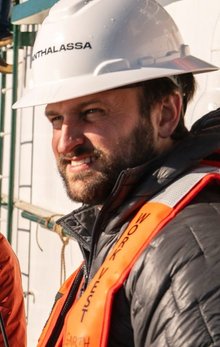
Garth Sheldon-Coulson, Panthalassa's Co-Founder and CEO, is a former AI and energy researcher at hedge fund Bridgewater.
The company's motto is 'go where the energy is'.
"One of the key insights that we had was that it's very important to use the electricity in place," Garth tells the Financial Times (FT).
This decision sidesteps one of the most difficult problems in offshore renewables, which is the huge cost and complexity of subsea transmission cables and interconnectors.
The company has no intention of transmitting electricity back to shore.
Its commercial viability depends on selling compute capacity, not electricity.
By operating in remote, deep-ocean areas rather than near coastlines, Panthalassa's nodes could avoid the constraints that have hampered previous wave-energy projects, like land-sea connections and inconsistent waves.
"The waves are like a battery for sunlight and we can be capturing from it 24/7," Garth adds.
Tech industry's compute challenge
Garth has made a case for why wave energy deserves consideration alongside solar and nuclear.
"Energy from open-ocean waves is low cost, sustainable, abundant and now we have the technology to make it accessible for people," he tells the FT.
The company contends that wave and wind power are, alongside solar and nuclear, the only clean-energy sources capable of producing tens of terawatts.
This is the scale that AI infrastructure is increasingly demanding.

With global demand for clean energy climbing, this argument could interest both private and public sectors.
Peter sees the company's mission as expanding technological frontiers.
"The future demands more compute than we can imagine. Extraterrestrial solutions are no longer science fiction. Panthalassa has opened the ocean frontier," he tells the FT.
Manufacturing and deployment plans
The new capital will fund a pilot manufacturing facility in the US, with the firm looking at its first proper commercial deployments next year.
When it comes to manufacturing, Panthalassa says that its nodes are made using only earth-abundant materials like steel.
This could relieve pressure on rare-earth mineral and critical-mineral supply chains, which are already stretched by data centre expansion and the energy transition.
The company has suggested that the supply chains its products will rely on are robust enough to facilitate a period of rapid scaling.
While some critics have described Thiel's support for ocean-based infrastructure as a form of tech neocolonialism, his backing will likely lend momentum to Panthalassa's push towards mainstream adoption in the tech sector.
Company portals





Executives
Garth Sheldon-Coulson
Co-Founder & CEO
Marc Benioff
Chair & CEO

Peter Thiel
Co-Founder