Toyota & Agility Robotics: The Age of Robots-as-a-Service
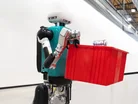
Toyota's Woodstock factory in Canada is getting a new robot team member.
The Japanese automotive giant has signed a Robots-as-a-Service agreement with Agility Robotics to deploy Digit, a commercially available humanoid robot, at its Woodstock facility following a successful pilot programme.
The move could represent a significant development in enterprise robotics deployment, as Toyota Motor Manufacturing Canada transitions from purely proprietary automation systems to integrating third-party robotic platforms.
Tim Hollander, President of Toyota Motor Manufacturing Canada, says: "Toyota Motor Manufacturing Canada has long been a leader in automotive manufacturing innovation.
"After evaluating a number of robots, we are excited to deploy Digit to improve the team member experience and further increase operational efficiency in our manufacturing facilities."
Digit's technical specifications and capabilities
Digit is billed as the world's first commercially deployed humanoid robot, engineered with approximately 5,000 individual components.
The system operates using a hybrid approach that combines traditional control systems with AI-based learning methods.
This enables deployment cycles measured in hours rather than the weeks or months typically associated with industrial automation integration.
The robot's functional capabilities include line feeding, tote loading and unloading and tote recycling operations.
Agility Robotics manufactures Digit units at its RoboFab facility in Oregon, US, which could produce up to 10,000 units annually at peak capacity.
Toyota's Woodstock West plant, which manufactures the RAV4 and RAV4 Hybrid models, will serve as the deployment site.
The facility operates using Toyota New Global Architecture platforms, which standardise vehicle components and assembly processes across different model lines.
The Ontario, Canada plants recently underwent a CA$1.1bn (US$803m) reconfiguration to enable in-house hybrid battery pack production, eliminating the previous reliance on imports from Japan.
The subscription model approach
Rather than purchasing the robots outright, Toyota is implementing them through Agility's Robots-as-a-Service model.
This subscription-based approach could allow the automotive manufacturer to upgrade hardware as new iterations become available without facing depreciation on capital equipment investments.
Agility Robotics manages ongoing maintenance and support, controlled through Agility Arc, a cloud-based fleet management platform.
The system enables plant managers to assign tasks remotely, monitor real-time battery levels across deployed units and reconfigure operations when factory floor layouts change.
According to Peggy Johnson, CEO of Agility Robotics, the partnership could extend beyond current capabilities.
"Toyota is one of the premier companies in the world; one with a long history of innovation and success, so it’s a privilege to join forces to integrate humanoid robotic solutions like Digit into automotive production," Peggy says.
"I look forward to continuing our work with Toyota to identify all the ways that Digit can help the employees working at their production facilities.
"With our next generation of Digit, we will be the first company to deliver the first cooperatively safe humanoid robot to work alongside people, allowing companies like Toyota to scale their use of humanoids well beyond what is possible today."

The service model represents a shift from traditional capital expenditure approaches to operational expenditure frameworks in manufacturing automation.
This allows for greater flexibility in scaling robotic deployments based on production demands.
Evolution of Toyota's automation strategy
The Digit deployment could mark a strategic pivot for Toyota, which has historically developed proprietary robotic systems.
The company first integrated industrial robots into manufacturing operations during the 1970s, guided by the Toyota Production System and its Jidoka principle, which emphasises automation with a human touch.
Toyota began engineering specialised industrial robots internally during the 1980s, leveraging sensor and mobility control technologies originally developed for automotive applications.
The company's robotic initiatives date to 2013, with experimental projects such as Kirobo, a 34cm humanoid that operated aboard the International Space Station for 18 months.
Additional projects included the T-HR3, a humanoid system unveiled in 2017 that replicates remote human operator movements.
These experimental platforms demonstrated Toyota's long-standing interest in humanoid robotics technology.
The transition to commercially available humanoid platforms could suggest that enterprise robotics technology has matured to a point where third-party solutions can meet the rigorous operational requirements of advanced manufacturing environments previously served only by bespoke systems.
Company portals


Executives
Peggy Johnson
Chief Executive Officer

Tim Hollander
President, Toyota Motor Manufacturing Canada