
What is the Technology Powering the Artemis II Moon Mission?
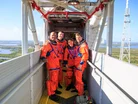
The Artemis II mission represents the most significant leap in crewed spaceflight in more than 50 years.
While the twentieth century was defined by a race to prove lunar arrival was possible, this mission marks the transition from exploration to sustained presence.
Scheduled to launch as soon as 1 April 2026, NASA will send four astronauts on a 10-day journey that pushes the boundaries of human endurance and mechanical precision.
Travelling more than half a million miles, the crew will venture further from Earth than any humans in history, orbiting the far side of the Moon to test the vital systems required for future planetary colonisation.
This is set to be a stress test for a new era of technology.
From the most powerful rocket ever built to the “mini-wearable spacecraft” of the Orion survival suits, every component has been engineered to withstand the vacuum of space and the searing heat of re-entry.
As Mission Commander Reid Wiseman notes to the BBC: “It is a test mission and we are ready for every scenario.”
This voyage serves as the ultimate precursor to a permanent Moon base, providing the data needed to eventually travel towards Mars.
A brief history of humans travelling to the Moon
For more than 50 years, the lunar surface has remained untouched by humans themselves.
The Apollo era, which peaked with the final mission in 1972, proved that humanity could reach the Moon using the computing power of the mid-20th century.
Now, NASA is set to return.
While Apollo was a series of “flags and footprints”, Artemis II is the critical bridge to a permanent lunar presence.
This mission will send four astronauts on a journey of more than half a million miles, travelling farther from Earth than any humans before.

The powerhouse: SLS and the Orion spacecraft
The sheer scale of the technology powering Artemis II is record-breaking.
At the heart of the launch is the Space Launch System (SLS), the most powerful rocket NASA has ever built.
Standing 98 metres tall, the SLS uses a core stage containing more than three million litres of liquid hydrogen and liquid oxygen, surrounded by two solid rocket boosters.
Sitting on top of the SLS is the Orion spacecraft, the vessel that will house the crew for their 10-day voyage.
Unlike the Apollo capsules, Orion features a modernised interior.
While the crew will be “crammed together in a spacecraft the size of a minibus,” according to the BBC, the technology inside is leaps ahead of its predecessors.
For example, the glass cockpit features fully digital control panels that can be operated from the ceiling in microgravity.
There will also be advanced water dispensers for rehydration and a specially designed space toilet, a luxury the Apollo astronauts lacked.
“It is a test mission and we are ready for every scenario,” says Reid. “It’s going to be amazing.”
However, the development of Orion hasn’t been without hitches.
Engineers recently had to replace an electrical harness for the flight termination system and fix a dislodged seal in the helium flow system.
These “loose wire” fixes in the Vehicle Assembly Building ensure that when the SLS finally ignites, every component is flight-ready.
ESM and the digital brain
While the SLS provides the initial force, the mission’s longevity depends on the European Service Module (ESM), which houses 33 engines.
Developed by the European Space Agency (ESA) and Airbus, the ESM provides propulsion, electrical power and thermal control to the spacecraft.
Plus, Orion is the first NASA crewed deep-space vehicle to use solar panels instead of fuel cells.
Four X-shaped solar wings, spanning 19 metres, contain over 15,000 gallium arsenide cells, generating 11.2 kW of power, which is enough to run two average households.
A complex network of radiators and cold plates regulates the interior temperature of Orion, protecting the crew and electronics from the extreme 200°C to -200°C fluctuations of the lunar environment.
Powering the mission’s logic are the Vehicle Management Computers.
These are derived from the Boeing 787’s flight computers but have been “ruggedised” and radiation-hardened to survive the Van Allen belts.
The Van Allen belts are two, high-radiation regions that surround Earth and which the spacecraft has to fly through.
For the Artemis II mission, the Vehicle Management Computers need to be radiation-hardened because passing through these belts exposes the electronics to intense radiation that could easily damage or cause a failure in a standard computer.
Each computer constantly checks the others; if one malfunctions due to radiation, the others outvote it instantly.
The crew
The mission relies as much on human intuition as it does on hardware.
The four-person crew – Commander Reid Wiseman, Pilot Victor Glover, and Mission Specialists Christina Koch and Jeremy Hansen – bring decades of expertise.

“Depending on the time that we launch, depending on the illumination of the far side of the Moon [...] we could see parts of the Moon that never have had human eyes laid upon them before,” says Christina.
“And believe it or not, human eyes are one of the best scientific instruments that we have.”
The astronauts will also serve as biological experiments.
They will carry dosimeters to measure radiation exposure and provide saliva samples to study how deep space affects the human immune system.
What’s the impact on manufacturing, AI and broader technology?
The Artemis programme is a massive catalyst for the global technology sector.
The manufacturing requirements for the SLS and Orion have pushed materials science to its limits.
For example, the Orion heat shield must withstand temperatures of 2,700°C (half as hot as the surface of the sun) as it hits the atmosphere at 25,000mph.
In the realm of AI and automation, the mission’s complexity requires sophisticated digital twin modelling and autonomous systems.
While the astronauts will manually fly Orion to test its handling, the vast majority of the trajectory and life-support monitoring is handled by advanced algorithms.
Plus, the “monthly cadence” of missions proposed by new NASA Administrator Jared Isaacman suggests a shift toward industrialised spaceflight.
This move impacts the manufacturing sector by transitioning from bespoke, one-off builds to a more sustainable production line of lunar hardware.
The risky return to Earth
The mission concludes with a “terrific and terrifying” re-entry.
After a lunar fly-by where the crew will lose communication with Earth for up to 50 minutes, they will begin a four-day journey home.
If Artemis II succeeds, it will validate the most advanced transport system ever devised, turning the Moon from a distant light in the sky into a functional laboratory for the future of the human race.
Company portals



Executives

Jared Isaacman
Administrator