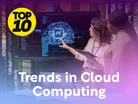
Nowadays, cloud computing is part of the fabric of the modern enterprise.
One needs only consider the amounts of money that companies spend on the cloud to understand its importance.
Recent projections by Gartner suggest that end-users will spend north of US$723bn on cloud technologies by the end of 2025.
This nigh-on incomprehensible figure speaks to another of the conventional wisdoms about the cloud in today's economy: it is now a driver of value, with returns on investment far more tangible than they ever were before.
And this new era for the cloud is defined by one catalyst more than any other: artificial intelligence. AI is rapidly reshaping cloud architecture, economics and security.
From driving unprecedented infrastructure demand to necessitating autonomous operational agents, AI is becoming the sun around which all other trends pertaining to the cloud now orbit.
As the clamour for AI continues to swell, so too will the demand for cloud technologies. In this week's Top 10, we shine a light on some of the trends that are defining the ongoing rise of the cloud.
10. Quantum Computing as a Service (QCaaS)
Company in focus: IBM
CEO: Arvind Krishna
Product in focus: IBM Quantum Platform
Notable feature: Provides cloud access to the world's largest fleet of quantum systems, including processors with over 1,000 qubits.
While still in its infancy, quantum computing is becoming accessible through the cloud, allowing organisations to experiment without the immense cost of building their own quantum hardware. This trend is about preparing for future disruption.
By leveraging Quantum Computing as a Service (QCaaS), firms in finance, pharmaceuticals and materials science can begin developing next-generation algorithms for complex optimisation and simulation problems.
This early access provides a crucial strategic advantage, building internal expertise for the moment quantum computing achieves mainstream commercial viability.
9. Industry-specific clouds
Company in focus: Microsoft
CEO: Satya Nadella
Product in focus: Microsoft Cloud for Healthcare
Notable feature: Integrates capabilities from Azure, Microsoft 365 and Dynamics 365 to address specific healthcare challenges.
The era of one-size-fits-all cloud platforms is maturing. In 2025, industry clouds are gaining significant traction by offering curated, vertically-integrated solutions.
These platforms come with pre-built compliance frameworks, specialised data models and tailored workflows for sectors like finance, healthcare and manufacturing.
For businesses in highly regulated fields, this accelerates digital transformation by solving complex, sector-specific challenges out of the box, reducing risk and speeding up time-to-market for new products and services.
8. The rise of low-code and no-code systems
Company in focus: OutSystems
CEO: Woodson Martin
Product in focus: OutSystems Platform
Notable feature: A full-stack low-code platform for enterprise-grade applications with strong governance and AI integration features.
The relentless pressure to innovate is being met by platforms that abstract away infrastructure complexity.
Serverless computing, offered by services like AWS Lambda, allows developers to run code without managing servers, as scaling is handled automatically.
In parallel, low-code/no-code (LCNC) platforms are empowering non-technical "citizen developers" to build and deploy applications using intuitive visual interfaces.
Together, these trends are dramatically accelerating development cycles and broadening the pool of creators within an organisation.
7. Sustainable cloud computing
Company in focus: Google Cloud
CEO: Thomas Kurian
Product in focus: Carbon Footprint tool
Notable feature: Provides customers with detailed reports on the gross carbon emissions associated with their cloud usage.
Sustainability has transitioned from a corporate social responsibility footnote to a core business driver.
With data centres consuming a significant portion of global electricity, enterprises are now scrutinising the environmental credentials of their cloud providers.
Major players are responding with ambitious goals, such as powering their operations with 100% renewable energy and offering sophisticated tools that allow customers to measure, report and reduce the carbon footprint of their workloads, aligning IT strategy with crucial ESG objectives.

6. FinOps and cloud economics
Company in focus: Apptio (an IBM company)
GM: Ajay Patel
Product in focus: Cloudability
Notable feature: A leading FinOps platform providing visibility, optimisation and governance across multi-cloud environments.
As cloud spending continues its steep ascent, particularly with resource-intensive AI workloads, simple cost-cutting is no longer sufficient.
FinOps has emerged as an essential business discipline, creating a cultural practice of financial accountability for the variable spend model of the cloud.
By fostering collaboration between finance, engineering and business teams, FinOps enables organisations to maximise the business value of every pound spent, improve forecasting accuracy and ensure cloud investments are both efficient and effective.
5. Advanced cloud security
Company in focus: Darktrace
CEO: Jill Popelka
Product in focus: Darktrace / CLOUD
Notable feature: Uses unsupervised machine learning to learn an environment's 'normal' pattern of life and autonomously responds to threats.
With the cost of cybercrime projected to reach an astonishing US$12tn in 2025, traditional, reactive security measures are proving inadequate.
The modern defence strategy is proactive and data-driven, built on principles like Zero Trust Architecture, which assumes no user or device is inherently trustworthy.
This approach is increasingly powered by AI, which can analyse vast datasets in real-time to detect subtle anomalies and neutralise sophisticated threats across complex, distributed cloud environments before they can cause significant damage.
4. The expansion of intelligent edge
Company in focus: Hewlett Packard Enterprise (HPE)
CEO: Antonio Neri
Product in focus: HPE ProLiant Gen12 Edge Servers
Notable feature: Purpose-built for running industrial AI workloads with enhanced compute density outside of a traditional data centre.
Edge computing is rapidly moving from a niche technology to a mainstream strategy, extending the power of the cloud closer to where data is generated and actions are taken.
Propelled by the explosion of IoT devices and the widespread rollout of 5G networks, the intelligent edge enables real-time data processing and AI-powered decision-making.
This is critical for latency-sensitive applications in fields like industrial automation, autonomous vehicles and smart retail, creating a symbiotic relationship where the edge acts as the cloud's sensory system.
3. Cloud-native technologies
Company in focus: Red Hat (an IBM company)
CEO: Matt Hicks
Product in focus: Red Hat OpenShift
Notable feature: An enterprise Kubernetes platform providing a consistent application environment across hybrid, multi-cloud and edge deployments.

Building applications for the cloud, rather than just lifting and shifting them into the cloud, is now the undisputed standard for modern software development.
Cloud-native architecture – which leverages technologies like containers, managed by orchestration platforms such as Kubernetes and microservices – foundational to achieving business agility.
This approach allows organisations to build highly scalable, resilient and flexible applications that can be updated and deployed rapidly and independently.
With Gartner predicting that more than 95% of new digital workloads will be cloud-native by 2025, mastering this paradigm is no longer just optional, it's quickly becoming essential.
2. Hybrid and multi-cloud technologies
Company in focus: VMware (by Broadcom)
CEO: Hock Tan (Broadcom)
Product in focus: VMware Cloud Foundation
Notable feature: Provides a consistent infrastructure and operational layer across private data centres and public clouds for seamless workload management.
The era of allegiance to a single cloud vendor is decisively over. In 2025, hybrid and multi-cloud strategies are the norm, with nearly 90% of enterprises embracing this approach.
Businesses now strategically distribute their workloads across multiple public clouds – such as AWS, Azure and Google Cloud – and their own private infrastructure.
This provides ultimate flexibility, allowing them to cherry-pick best-of-breed services for specific tasks, enhance resilience against outages, avoid vendor lock-in and rigorously adhere to complex data sovereignty and compliance regulations that dictate where sensitive information must reside.
1. Agentic AI
Company in focus: OpenAI
CEO: Sam Altman
Product in focus: GPT-5 (and successor models)
Notable feature: Advanced reasoning and tool-use capabilities that form the 'brain' for autonomous agents interacting with cloud services.
The most transformative trend of 2025 is the leap from Gen AI as a passive assistant to Agentic AI as an active, autonomous participant in cloud operations.
These intelligent software agents are given high-level business goals – such as "optimise our AWS costs this quarter" or "secure all public-facing storage buckets" – and can independently reason, plan and execute the complex, multi-step workflows required to achieve them.
This heralds a new era of self-managing, self-optimising and self-healing cloud infrastructure, fundamentally changing the role of human operators from hands-on technicians to high-level strategists overseeing fleets of AI agents.
Company portals





Executives
Ajay Patel
General Manager of Apptio & IBM IT Automation
Antonio Neri
President & CEO

Arvind Krishna
CEO
Hock Tan
President and Chief Executive Officer
Jill Popelka
Chief Executive Officer

Sam Altman
Satya Nadella
Chairman and CEO

Thomas Kurian
CEO
Woodson Martin
CEO