The ID Buzz: Uber Enlists Volkswagen for New Autonomous Taxi
Right now, the autonomous vehicle (AV) market is hugely competitive, with no single company reigning supreme.
In the US, Waymo and Zoox (backed by Google and Amazon respectively) are delivering limited services in certain major cities, while Tesla recently launched its long-awaited 'robotaxi' too.
The AV market is also growing quickly in Asia, with companies like Baidu, Curium and WeRide already well established in China, Singapore and the UAE.
But while green shoots are visible around the world, no companies have asserted their dominance just yet.
With the race still very much on, Uber, the world's largest taxi-hailing network, has decided to throw its hat into the ring.
The American company is working closely with Volkswagen to develop its own product, capable of competing with allcomers.
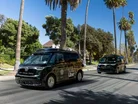
The ID. Buzz is that product: an environmentally-friendly electric minivan that both Uber and VW hope will come to redefine urban mobility for years to come.
A new take on an old classic
The ID. Buzz represents Volkswagen's contemporary reinterpretation of its legendary Microbus, now constructed on the company's Modular Electric Drive (MEB) platform.
Engineered with sustainability and urban functionality at its core, the vehicle offers:
- A 91-kWh battery delivering up to 234 miles of range
- Fast DC charging (10–80% in 26 minutes)
- Rear-wheel and all-wheel drive options with up to 335 horsepower
- Recyclable components and EV-specific low-drag engineering
The vehicle's retro-influenced styling is combined with a sophisticated driver assistance system and comprehensive sensor arrays, making it appropriate for Level 4 autonomous operation, meaning it can be operated without human intervention in specific geographies and weather conditions.
The ID. Buzz also is also designed for ride-sharing, meaning that its seats can be configured however a particular group needs them.
"Autonomous driving is no longer a dream of the future – by 2030, it will change the everyday lives of millions of people in Europe," says Christian Senger, Member of the Board for Fully Autonomous Mobility and Transport at Volkswagen Commercial Vehicles & CEO of ADMT GmbH.
Tests are underway
Just as the testing ground for autonomous vehicles in the US has been San Francisco, the urban hub of Silicon Valley, Hamburg — a techy city close to VW's Wolfsburg HQ — will be the proving ground for the ID. Buzz.
Around 30 of the minivans are currently being tested by Volkswagen in Hamburg, all of which are accompanied by safety drivers should the vehicles need overriding.
The initiative represents part of a wider goal to incorporate self-driving vehicles into public and private transport systems.
"At the same time, our solution opens up a new business area for the German automotive industry: physical AI applications used for the common good."
In 2026, the ID. Buzz is expected to make its debut in Los Angeles through Uber's platform.
Rather than fixed-route services, the LA rollout will be about providing a flexible, on-demand car-pooling service, giving passengers the ability to request individual rides when they need.
VW also intends to phase out its safety drivers in Los Angeles by the end of 2026, with limited runs in European cities expected to follow by 2027.
“The ID. Buzz is Volkswagen’s next iconic vehicle for North America,” says Pablo Di Si, Former President and CEO of Volkswagen Group of America.
“It serves as our brand halo in the US and Canada and embodies the best of Volkswagen: distinctive design, fun to drive, loaded with technology, incredibly spacious and sustainable.
“It also honours the past by evoking the classic Minibus while embracing the future of our industry."
Autonomous tech, sustainable infrastructure
The ID. Buzz AV utilises Mobileye's autonomous driving platform, employing 13 cameras, 9 LiDARs and 5 radars.
This sensor configuration produces five gigabytes of data per second, facilitating real-time mapping and object recognition.
Volkswagen's adoption of proprietary mapping tools and independence from GPS enhances resilience in unpredictable or infrastructure-limited environments.
In contrast to retrofitted EVs employed by other robotaxi operators, Volkswagen's choice to manufacture the ID. Buzz AV on its own production lines guarantees superior cost-efficiency and diminished environmental impact through optimised manufacturing.
Uber has announced the technological features that its service will boast, including:
- NFC-enabled keyless entry via smartphone
- Cabin cameras for behavioural monitoring and object detection
- AI-assisted safety interventions, including remote communication
- Emergency stop controls for passengers
All in all, it's an exciting time for Uber, Volkswagen and the general public. Within the next few years, this partnership could be the largest force in the entire AV sector, with huge potential to scale the technology as a whole.
With Uber's unmatched network of passengers and VW's global supply chain and portfolio (which includes brands like Audi and Porsche), the sky is the limit, and the sector is abuzz.