How NVIDIA Vera Rubin DSX Redefines AI Infrastructure Design
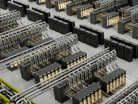
NVIDIA's announcement from GTC 2026 could signal a fundamental shift in how AI data centres are designed, built and operated.
At the heart of this transformation lies the Vera Rubin DSX AI Factory reference design, a codesigned infrastructure that treats compute, power and cooling as integrated components rather than separate systems.
Alongside the physical architecture, the company releases its Omniverse DSX digital twin blueprint, enabling operators to build, test and optimise entire facilities virtually before breaking ground.
The technology addresses a critical challenge facing the AI industry: as models scale and computational demands intensify, traditional data centre designs struggle to keep pace.
NVIDIA's approach reimagines the data centre as a unified system where hardware, software and operational technology converge.
"In the age of AI, intelligence tokens are the new currency and AI factories are the infrastructure that generates them," says Jensen Huang, founder and CEO of NVIDIA.
"With the NVIDIA Vera Rubin DSX AI Factory reference design and Omniverse DSX Blueprint, we are providing the foundation to build the world's most productive AI factories, accelerating time to first revenue and maximising scale and energy efficiency."
Major technology and engineering firms including Cadence, Dassault Systèmes, Eaton, Jacobs, Schneider Electric, Siemens, Switch and Vertiv align behind the initiative.
Digital twin technology drives design
The Omniverse DSX Blueprint represents a standardisation of how compute, storage, networking and operational systems integrate.
By unifying these layers, the technology enables large-scale deployments to become more predictable and efficient.
Digital twin capabilities sit at the core of this approach.
Before physical construction begins, operators can model entire AI factories in virtual environments, testing configurations for power distribution, thermal behaviour and network topology.
This simulation-first methodology allows teams to identify inefficiencies and optimise layouts without the cost and risk of physical prototyping.
The virtual modelling process provides granular insight into how systems interact under different conditions.
Engineers can stress-test infrastructure scenarios, evaluate alternative equipment configurations and predict performance outcomes with precision that traditional planning methods cannot match.
The technology extends beyond the design phase.
Once facilities become operational, digital twins enable continuous monitoring and real-time adjustment of workloads and infrastructure.
Using the NVIDIA DSX Air platform, operators can model GPUs, networking components and partner infrastructure, whilst 3D geometry and logistics simulations help accelerate deployment.
Software stack balances performance and energy
The Vera Rubin DSX software stack connects hardware with power and cooling systems through an open, modular architecture. At its foundation, the DSX Max-Q library works to maximise AI tokens per watt of available energy by optimising workloads within fixed power budgets.
DSX Flex introduces another layer of sophistication by linking AI facilities to power grid services.
This enables dynamic adjustment of energy consumption and coordination with hybrid onsite generation, helping data centres reduce their draw while supporting grid stability during peak demand periods.
The DSX Exchange component facilitates secure, scalable integration of signals across compute, networking, energy, power and cooling systems.
This bridges traditionally siloed IT, operational technology and operations teams, creating a unified control plane for facility management.
Energy efficiency features prominently in the architecture.
The modular design links compute directly with power and cooling infrastructure, enabling real-time balancing of performance against available energy as facilities scale towards gigawatt levels.

Industry adoption accelerates infrastructure innovation
Technology and engineering companies are incorporating the Vera Rubin DSX reference design and Omniverse DSX Blueprint into their platforms.
Dassault Systèmes is integrating the reference design into its Model Based Systems Engineering platform to build virtual twins of AI factories, targeting faster deployment alongside improved reliability.
Schneider Electric and Eaton are providing digital twin models and simulation tools focused on power distribution and cooling optimisation.
Cadence is using SimReady models of NVIDIA GB300 NVL72 to simulate thermal and fluid dynamics, supporting operators in planning high-density compute environments.
Switch is leveraging Omniverse DSX for real-time telemetry and continuous digital twin updates.
CoreWeave uses NVIDIA DSX Air in the cloud to build and test digital twins, running operational rehearsals before physical deployment to compress validation timelines.
The convergence of simulation technology, real-time monitoring and integrated system design marks a departure from static infrastructure builds.
Facilities can now be designed, tested and refined continuously, with digital twins providing a feedback loop that informs both immediate operational decisions and long-term infrastructure planning.




Executives
Jensen Huang
Founder and CEO