How is Nvidia Shaping the Future of AI and 6G?
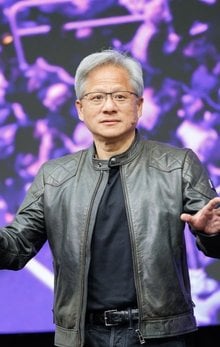
Nvidia has reached a US$5tn market capitalisation following a series of partnerships and product announcements by CEO Jensen Huang at Nvidia’s GTC Washington DC event.
There, it detailed its vision for the future of AI and accelerated computing with a focus on American manufacturing.
Jensen also reveals Nvidia has US$500bn in bookings for its upcoming Blackwell and Rubin chips over the next five quarters.
“We are going through a platform shift,” he says.
“That shift is a once-in-a-lifetime opportunity for us to get back into the game for us to start innovating with American technology. Today, we are announcing that we are going to do that.”
Nvidia ARC to power 6G development with Nokia
At the conference, Nvidia announced a US$1bn partnership with telecommunications equipment manufacturer Nokia.
The collaboration is intended to position the US as a leader in the next generation of 6G wireless technology by leveraging Nvidia's work in accelerated computing and AI.
The foundation for this initiative is Nvidia’s new product line called Nvidia Aerial RAN Computer (ARC).
This system is built using three core technologies: the Grace CPU, the Blackwell GPU and Mellanox ConnectX networking. Nokia plans to integrate the Nvidia ARC platform into its base stations globally.
The ARC system is a software-defined programmable computer designed to handle both wireless communication and AI processing.
Justin Hotard, President and CEO of Nokia, says: “The next leap in telecom isn’t just from 5G to 6G, it’s a fundamental redesign of the network to deliver AI-powered connectivity, capable of processing intelligence from the data centre all the way to the edge.
“Our partnership with Nvidia, and their investment in Nokia, will accelerate AI-RAN innovation to put an AI data centre into everyone’s pocket.”
AI supercomputers and quantum-GPU integration
Jensen also announced a partnership with the Department of Energy to build 7 new AI supercomputers aimed at advancing scientific research in the nation.
“Today we are announcing that the Department of Energy has partnered with Nvidia to build seven new AI supercomputers to advance our nation’s science,” Jensen says.
A new interconnect architecture named NVQLink has been introduced, which directly connects quantum processors with Nvidia GPUs.
This technology is capable of moving terabytes of data between quantum hardware and the GPUs to perform error corrections.
This quantum-GPU computing is powered by CUDA Q, Nvidia’s platform for quantum computing.
NVQLink can also connect quantum processing units (QPUs) and GPU supercomputers to conduct hybrid simulations, allowing quantum and classical computing to work together to improve performance.
According to Jensen, this integration represents the future of quantum computing.

Advancing autonomous vehicles and enterprise AI
In the transport sector, Nvidia is partnering with Uber to develop Level 4 autonomous vehicles.
Nvidia’s new Drive Hyperion provides a reference compute and sensor architecture that enables vehicle manufacturers to create models ready for robotaxi deployment.
Dara Khosrowshahi, CEO of Uber, explains: “Nvidia is the backbone of the AI era, and is now fully harnessing that innovation to unleash L4 autonomy at enormous scale, while making it easier for Nvidia-empowered AVs to be deployed on Uber.
“Autonomous mobility will transform our cities for the better and we’re thrilled to partner with Nvidia to help make that vision a reality.”
Uber intends to deploy 100,000 autonomous vehicles in 2027 using a joint AI factory built on the Nvidia Cosmos platform.
Additionally, Nvidia reveals a partnership with Palantir to build an integrated operational AI technology stack.
This will combine Nvidia’s accelerated computing CUDA-X libraries and open-source Nemotron models within Palantir’s Ontology framework.
“Palantir is focused on deploying AI that delivers immediate, asymmetric value to our customers,” says Alex Karp, Co-Founder and CEO of Palantir Technologies.
“We are proud to partner with Nvidia to fuse our AI-driven decision intelligence systems with the world’s most advanced AI infrastructure.”
Nvidia also announces Omniverse DSX, a stack to support the construction of AI factories.
These partnerships and systems could show Nvidia is extending its influence from chip manufacturing into telecommunications, transport, national research and enterprise AI infrastructure, shaping the architecture of the AI era.




Executives
Dara Khosrowshahi
CEO
Jensen Huang
Founder and CEO
Justin Hotard
President and CEO