This Week’s Top Five Stories in Technology
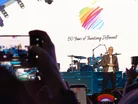
50 Years of Apple: From a Garage to a Global Giant
Apple is celebrating its 50th anniversary this week, marking a half-century since its humble beginnings in a suburban garage.
Originally named Apple Computer, the company was founded on 1 April 1976 by Steve Jobs, Steve Wozniak and Ronald Wayne.
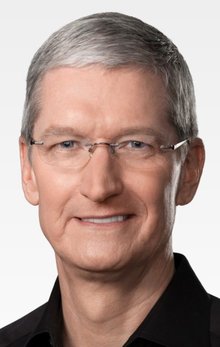
“Thinking different has always been at the heart of Apple,” says Tim Cook, Apple’s CEO.
“It’s what has driven us to create products that empower people to express themselves, to connect and to create something wonderful.
“As we celebrate 50 years, we are deeply grateful to everyone who has been part of this journey and who continues to inspire what comes next.”
Samsung Q1 Profits Rocket 755% Amid AI Memory Chip Shortage
The semiconductor industry has officially entered a new epoch.
Samsung Electronics released its first-quarter earnings guidance, projecting an operating profit of ₩57.2tn (US$38bn) and significantly exceeding market expectations.
To put that into perspective: Samsung’s profit in these three months alone is expected to surpass its entire operating profit for the 2025 fiscal year (₩5743.6tn).
The primary catalyst for this is the shift from general-purpose computing to AI-centric data centres.
High-bandwidth memory (HBM) – the specialised, vertically stacked silicon that feeds data to AI accelerators – has moved from a niche luxury to the industry’s most strategic asset.
OpenAI Pauses UK Data Centre Due to Energy and Policy Issues
OpenAI has paused its Stargate UK infrastructure project, halting progress on a planned data centre footprint as it reassesses conditions in the British market.
The company pointed to high industrial electricity prices and continuing regulatory uncertainty as the main reasons for suspending the rollout. An OpenAI spokesperson said the firm remains committed to the region: “We see huge potential for the UK’s AI future. London is home to our largest international research hub and we support the government’s ambition to be an AI leader.”
Announced in September 2025 with hardware partners Nscale and NVIDIA, Stargate UK was positioned to bolster sovereign compute capacity.
At the time, CEO Sam Altman said the partnership would “help accelerate scientific breakthroughs, improve productivity and drive economic growth,” building on the UK’s “world‑class researchers” and policy support for AI.

Scaling Convenience: Inside Glovo’s Global Tech Strategy
The global online food delivery services market is set to reach US$600 bn by 2033, according to Market Research Intellect.
Yet, as platforms scale, the complexity of managing a three-sided quick-commerce (Q-Commerce) marketplace – of customers, riders and partners – grows exponentially.
For technical leaders, the challenge has shifted from simply building an app to orchestrating a massive global infrastructure, one which Gartner predicts augmented engineering will soon save developers up to 40% of their time on routine tasks.
Glovo is a tech platform that connects millions of users with local restaurants, grocers and retailers. To work in this demanding market, its technical foundation needs to be robust enough to scale across 22 countries while remaining agile enough to innovate daily.
Shiro Theuri, Chief Technology Officer at Glovo, discusses how she balances rapid product expansion with the architectural discipline required to make convenience a global reality.
Why Women in Tech Day is About Strategy, Not Just Statistics
In the mid-1800s, Ada Lovelace looked at the Analytical Engine – a huge, mechanical precursor to the computer – and saw something others didn’t.
While her peers saw a machine for numbers, Lovelace saw a machine for possibility.
She wrote the first algorithm intended for a machine, earning her the title of the world’s first computer programmer.
Fast forward to today and, as we celebrate Women in Tech Day, it’s not just about honouring historical legacy – it’s about encouraging continual progression for women in technology.
While the numbers give us a baseline, with women making up just 35% of the tech workforce globally and holding only 25% of leadership roles, according to WomenTech Network, the real story of 2026 isn’t about the gap.
With 57% of women in tech considering leaving their roles due to growth hurdles, this day serves as a critical pulse check on how the industry can evolve from merely recruiting diverse talent to actively sustaining it through intentional sponsorship, equitable pathing and a culture that values judgment over pure velocity.
“One day there won’t be female leaders,” says Sheryl Sandberg, former CIO at Meta. “There will just be leaders.”
Company portals





Executives

Sam Altman
Sheryl Sandberg
Founder
Tim Cook
Executive Chairman