This Week’s Top Five Stories in Technology
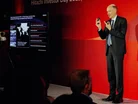
Hitachi Energy CTO on AI Data Centres Becoming Good Citizens
The rise of AI data centres has triggered an unprecedented challenge in our energy infrastructure.
While a conventional data centre can pull as much power as 100,000 homes, the International Energy Agency (IEA) estimates AI campuses currently under construction demanding up to 20 times that amount.
Unlike conventional data centres, which pull a predictable, well-managed continuous load from the power grid, AI data centres operate in vastly different phases.
The heavy computational training phase requires radically different energy profiles than the deployment phase.
This erratic power demand forces tricky new questions onto the table: Where do we position these facilities to get the power they need? What type of storage do we put into the data centre itself versus the utility connection? How do we guarantee power quality without injecting dangerous disturbances back into the public grid?
The Technology Behind the FIFA World Cup 2026
The FIFA World Cup 2026 is set to be the most technologically advanced sporting event in history, and at its centre – quite literally – is a revolution in officiating.
We’ve moved past the era of referees squinting at blurry replays to judge an offside or a handball. Instead, a partnership between Adidas and Lenovo is turning the entire field into a smart, digital playground where every move is tracked with perfect clarity.
The official match ball, the Adidas Trionda – Spanish for “three waves” to celebrate the fact that Canada, Mexico and the United States are co-hosting – is a feat of aerodynamic engineering.
Moving away from the multi-panel designs of the past, the Trionda features just four thermally bonded panels. Its surface is etched with micro-textures and intentionally deep seams that are designed to stabilise air drag much like the dimples on a golf ball, keeping the ball on course, whether it’s through Monterrey’s humidity or Vancouver’s wind.
Lenovo Combines AI and Digital Skills for Global Growth
Lenovo has climbed to seventh place globally in Gartner’s 2026 Global Supply Chain Top 25, advancing from eighth the previous year and 10th in 2024.
The technology giant’s recognition stems from its deployment of AI-driven automation and commitment to building a digitally skilled workforce capable of operating alongside intelligent systems.
As enterprises increasingly adopt autonomous technologies, Gartner’s research suggests that chief supply chain officers must prepare for integrated human-machine workflows.
The report emphasises that organisations need to align their learning and development programmes with emerging technologies and digital systems to enable seamless collaboration between human workers and automated processes.
Tech Mahindra’s President on the UK-India Digital Corridor
The bilateral trade landscape is poised for structural change when the new UK-India Free Trade Agreement, formally known as the Comprehensive Economic and Trade Agreement (CETA), officially enters into force next week on 15 July.
While mainstream commentary heavily emphasises tariff reductions on traditional physical commodities, the deeper economic potential rests in the formalisation of a sophisticated cross-border services framework.
Harshul Asnani, President and Head of Europe Business at Tech Mahindra, outlines the strategic potential of the new agreement.
“CETA’s biggest opportunity is not confined to goods,” he begins.
“It can create a stronger digital corridor between two complementary economies: the UK, with its strengths in AI research, financial services, regulation, cybersecurity, healthcare innovation and advanced technologies; and India, with its engineering depth, platform capability and delivery scale.”
Special Report: Justdiggit, McCain and Tend’s Agritech
Farming’s digital evolution is growing.
More than half (57%) of North American farmers say they will test new yield-increasing technologies by the end of 2026, according to McKinsey & Company’s Global Farmer Insights report.
Meanwhile in Europe, 93% of farmers are already using at least one IT or software tool, reports the European Commission in The State of Digitalisation in EU Agriculture.
Agriculture is an industry defined by its lack of control and growers are actively looking for a digital edge, but data-driven technology can be democratised so that everyone – from a smallholder farmer in Africa to a commercial grower in North America – can directly benefit from the tools they use.
Innovation in this space requires technology that adapts to nature’s unpredictability rather than trying to force it into a rigid algorithm.
By focusing on actionable, ground-level insights, modern agritech empowers farmers to make smarter daily decisions, optimise precious resource inputs, scale their businesses sustainably and ultimately prove their ecological stewardship to an increasingly eco-conscious public.
Company portals






Executives
Gerhard Salge
CTO
Harshul Asnani
President and Head of Europe